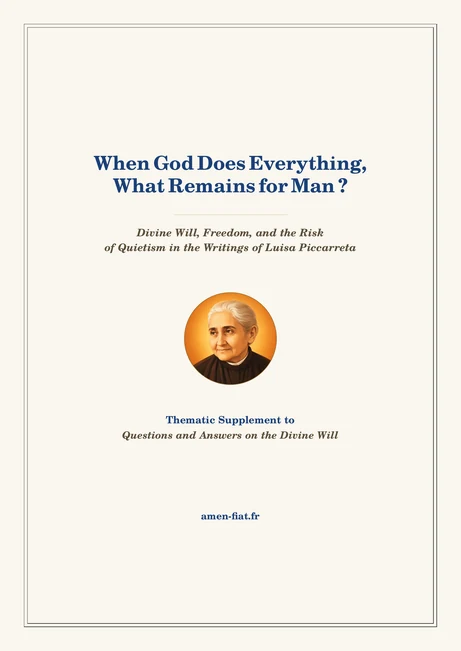
When God Does Everything, What Remains for Man?
Divine Will, Freedom, and the Risk of Quietism in the Writings of Luisa Piccarreta
Download the supplementSome phrases of Luisa Piccarreta, taken literally, seem to leave no room for the creature’s action: “You will do nothing; I will do everything.” This supplement starts from that vertigo without defusing it, to show what these words really change — and what they cannot mean.
The Vertigo, Then the Demonstration
The article begins with the most radical texts, without commenting on them in advance: the destruction of the virtues “in the human mode,” the simplicity of the Gift, the soul who “does nothing” and “does everything.” Only then does it name quietism — a spiritual doctrine truly condemned by the Church — to test, proposition by proposition, what distinguishes the abandonment Jesus taught Luisa from the passivity Rome rejected in Molinos.
The word that unties the paradox returns throughout the text: disposing oneself. Neither the price of the Gift nor a way of producing it — but the way a freedom makes itself present to what it receives.
Twelve Sections, One Question
- 1–4. What really changes with Luisa, the gratuitousness of the Gift, disposing oneself, and what “God does everything” leaves to the creature’s action;
- 5–6. The quietism of Molinos, condemned by the Church, and the Catholic boundary between prevenient grace and real cooperation;
- 7–9. No longer fighting the passions, the virtues destroyed, absorbed, become Life, and the daily duty that never disappears;
- 10–12. The boundary case of the sacraments, entering and leaving the Fiat without scrupulosity or false security, and the decisive word: dispositions.
An epilogue closes the supplement on the simplest thing Jesus himself says: to want, to take a step, then another.
“God does everything as Source, and the creature truly acts by receiving his movement. This is not a division of tasks. It is a relationship.”
A continuation, not a summary
This supplement does not restate the doctrine of the Divine Will: it tests it against one of its most real difficulties. What the Gift is, how it is communicated, the place of created freedom — the full work establishes all of this first, with its 214 questions and its articulation with Catholic doctrine.
All of Luisa’s quotations are verified against the complete Italian corpus, with volume and date; the magisterial sources — the Council of Trent, the Catechism, Veritatis splendor, Coelestis Pastor — are cited from their original texts.